
| As of 26.09.12, this page becomes
the home page for the 3cm Mow Cop .....................................receiver
running via WebSDR |
| *
alias signal reception: There have been a few comments/queries via the receiver text screen regarding the reception of GB3LEX and GB3CAM. The former is 100 kHz higher in frequency than the sound card sampling frequency whilst the latter, by co-incidence, is 100 kHz below, so both are at first thought, out of range of this receiver. However, if you consider sound card sampling as being a mixing process, you would expect an image response. This ought to be removed at source by the sound card anti-alias filter. In practice though, it takes the filter some 10 kHz beyond the 96 kHz sampling frequency to provide a lot of attenuation. This is easy enough to show by feeding a signal into the receiver, initially at the centre frequency (ie, DC as far as the sound card is concerned) and then moving away higher, as the picture shows below 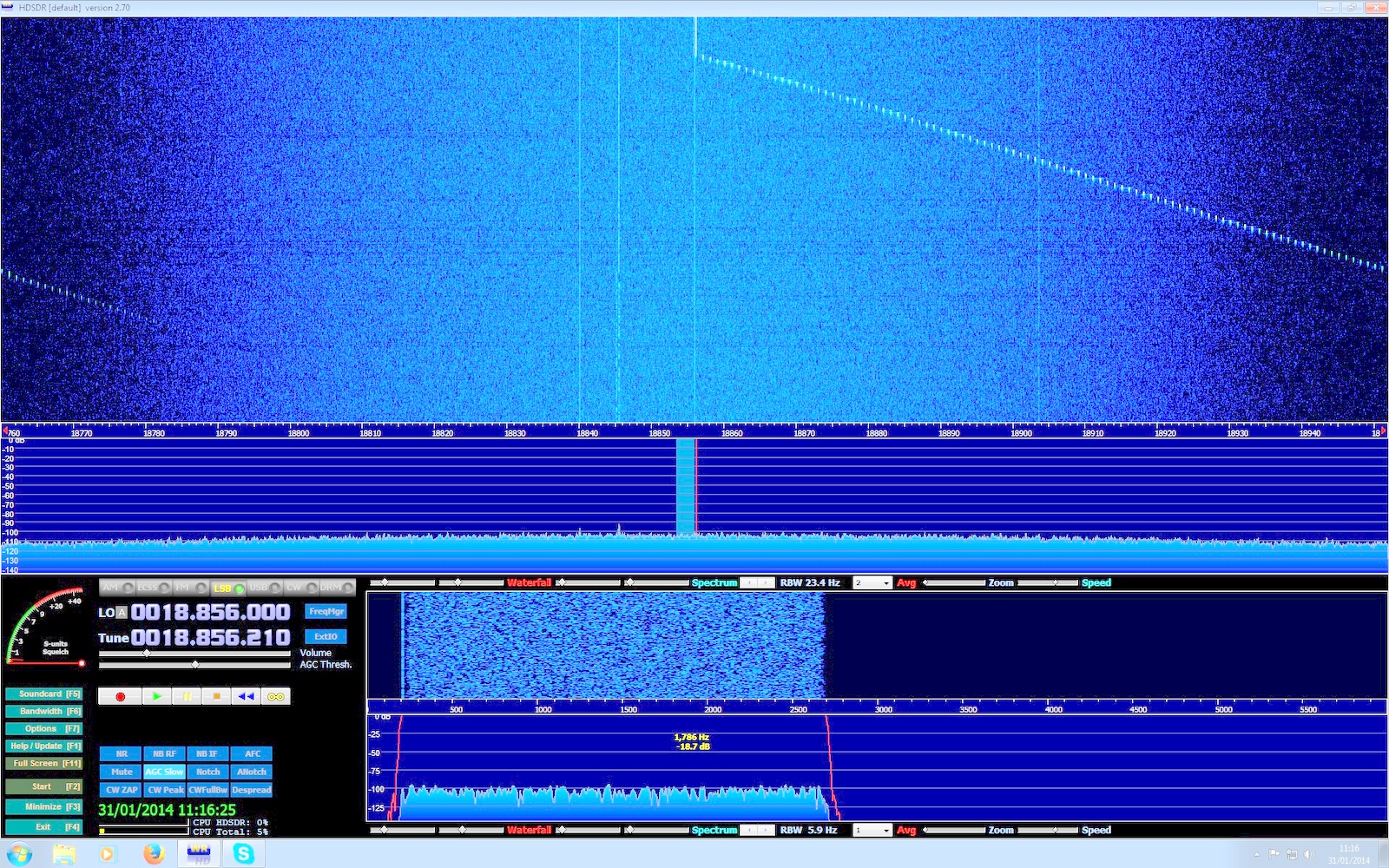 |
This particular signal was 30dB above noise floor, 1 kHz above centre frequency. As its frequency was increased, an eye was kept on this signal to noise ratio. It remained within a dB of this right up to 88 kHz above centre frequency. At 96 kHz it was 3 dB down. Increasing beyond the 96 kHz sampling frequency, the trace disappears off screen on the rhs, only to reappear on the lhs. It is the phasing nature of the receiver that causes this effect - if you detect using only the I or the Q audio signal, you see a more familiar sight:  ie, the image appears both sides. At 100 kHz offset, the signal to noise ratio has decreased by 10 dB, so when you see either GB3LEX or GB3CAM, the signal is actually 10 dB stronger than it appears. |
 |
Receiver description A Connor-Winfield ASOV5S3E 10 MHz OCXO should ensure that the frequency stability of the receiver remains better than +- 200Hz. The same antenna and LNB combination that was used for the Bawdsey receiver is used here, but a different IF is employed, based on an '80m Finningley SDR' board. In a bit of a Heath Robinson arrangement, the on-board 15 MHz crystal oscillator is replaced with an oscillator/multiplier board using a 12.570 MHz crystal multiplied by a factor of 6 to 75.420 MHz (in fact, it's another of the same multiplier boards used in the front-end 'Berniebox'). This results in an IF coverage of 18.855 MHz +- 96 kHz. Output from the SDR feeds an Asus Xonar D1 sound card fitted to the server. |
|
There are 12 pairs of slots
resulting in a gain
of 13.5dBi. Extensions, or wings, added to the narrow waveguide face reduce the variation in azimuthal gain to about +-2.3dB. (view radiation pattern picture in a seperate) window
(antenna pics/plot courtesy of David Wrigley) |
 |
 |
 |
  |
This particular LNB is
manufactured by WNG, and the 22mm coupler is a good tight intereference fit, which means that the mating copper tube wave- guide can be rotated without having to worry about the coupler itself rotating or coming loose, which is actually quite a useful feature. Probe skew (relative to the eliptical feed horn) ensures that it is not obvious what the correct alignment is for the copper tube waveguide, so being able to rotate this for best signal-to-noise ratio is very useful. |


 |
  |
 |

